- Interview: MohammadHosein Vahedi
At a Glance
- Iran’s foreign policy under Ayatollah Khamenei is characterized by strategic independence, anti-hegemonism, and resistance to external pressure.
- China views Iran as an important strategic partner and a key player in the emerging multipolar international order.
- Ayatollah Khamenei’s 1989 visit to China, President Xi Jinping’s 2016 visit to Tehran, and the signing of the 25-year Comprehensive Cooperation Plan in 2021 are identified as major milestones in bilateral relations.
- Beijing maintains that China–Iran relations have developed independently of either country’s relations with other major powers, including the United States.
- The Belt and Road Initiative has created broad opportunities for cooperation in trade, investment, energy, infrastructure, and connectivity.
- Regional instability and external interference remain the principal obstacles to realizing the full potential of bilateral cooperation.
- Looking ahead, declining Western influence in West Asia is expected to create new opportunities for Iran–China cooperation, while U.S. regional policies and ongoing security challenges are likely to remain significant sources of uncertainty.

Over the past three decades, relations between the Islamic Republic of Iran and the People’s Republic of China have evolved into one of the most consequential strategic partnerships in Asia. As the international system gradually transitions toward a more multipolar order, the role of Tehran and Beijing in regional and global affairs has attracted increasing attention from policymakers and scholars alike.
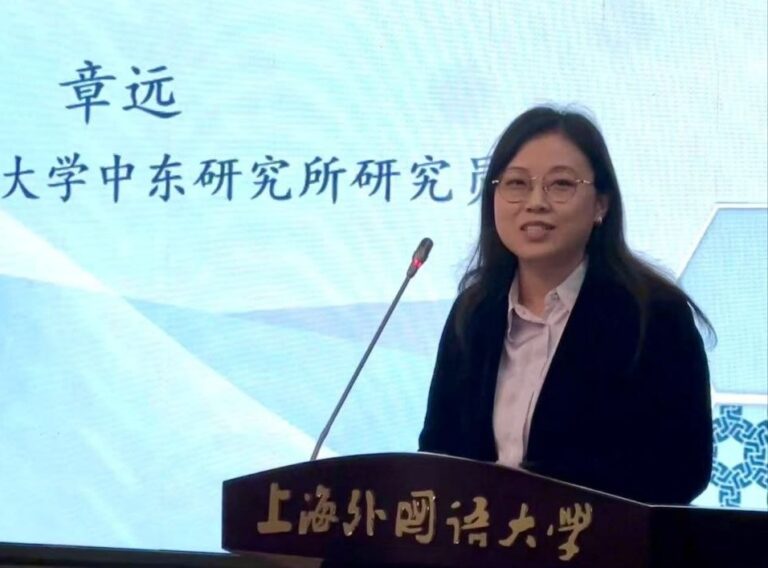
As part of its special series, “Three Decades of the Islamic Republic of Iran’s Foreign Policy under the Leadership of Ayatollah Seyyed Ali Khamenei: Achievements, Challenges, and Strategic Legacy,” Ravi Jahan spoke with Professor Zhang Yuan, Professor at the Middle East Studies Institute of Shanghai International Studies University, to explore how Chinese academic circles view Iran’s foreign policy, the evolution of Iran–China relations, Iran’s place in China’s strategic calculations, and the prospects for bilateral cooperation over the coming decade.
The full interview follows.
Ravijahan: From the perspective of Chinese intellectuals and academic circles, what is the most significant characteristic of the Islamic Republic of Iran’s foreign policy under the leadership of Ayatollah Khamenei?
Under the leadership of Ayatollah Khamenei, Iran’s foreign policy has been guided by the principles of anti-Americanism and anti-hegemonism. Skilled at leveraging competition among major powers to advance its national interests, Iran serves as an important balancing force on the international stage. Its diplomatic approach combines the pragmatic art of traditional diplomacy with a timely display of firmness to maintain regional deterrence. The religious foundation reflects the continuity of Iran’s diplomatic strategy, while the search for reliable allies exemplifies the flexibility of its diplomatic tactics. The spirit of resistance is the central theme of Iran’s external diplomatic narrative. Integrating into the international community and avoiding isolation have been consistent priorities for Iran.
Ravijahan: How have Iran–China relations evolved during the leadership of Ayatollah Khamenei? In your view, what have been the most important turning points in this relationship?
In 1989, then-President Khamenei visited China, marking a significant turning point in the warming of bilateral relations following the Islamic Revolution in Iran. Entering the 1990s, high-level exchanges between China and Iran became more frequent, and cooperation between the two countries deepened in areas such as defense, oil, and natural gas. This century, China and Iran have jointly upheld the purposes and principles of the United Nations Charter on the international stage and coordinated their efforts on many important international initiatives.
In 2016, President Xi Jinping’s visit to Iran elevated bilateral relations to a “Comprehensive Strategic Partnership,” taking the close ties between the two countries to a new historic height. President Xi Jinping’s visit to Iran was a milestone in bilateral relations, significantly enhancing political mutual trust between the two countries. In 2021, China and Iran signed the “China-Iran Comprehensive Cooperation Plan” (the 25-year strategic agreement), strengthening strategic connectivity and deepening economic and trade cooperation.
Following the outbreak of the U.S.-Israel war against Iran in 2026, China actively engaged in diplomatic efforts to promote peace. At the critical juncture in the unfolding situation, President Xi Jinping solemnly put forward four principles for maintaining and promoting peace and stability in the Middle East, emphasizing adherence to the principles of peaceful coexistence, national sovereignty, the rule of law, and the balanced approach to development and security. These contributions offered Chinese wisdom and solutions for resolving regional crises and promoting long-term stability and peace in the Middle East.
Ravijahan: As the international system transitions toward multipolarity, how do you assess Iran’s position in China’s strategic calculations?
China has always placed the development of its relations with Iran at the highest level of its diplomacy in the Middle East. Both China and Iran are ancient civilizations with a long history and a long-standing friendship. Both countries are committed to mutual development through cooperation and are important members of the “Global South.” China and Iran work closely together within frameworks such as the Shanghai Cooperation Organization (SCO) and BRICS to uphold multilateralism and are partners in promoting a multipolar international order.
Ravijahan: What opportunities has the Belt and Road Initiative created for long-term cooperation between Iran and China? What are the main obstacles to realizing these opportunities?
China remains committed to continuously deepening political mutual trust with Iran and strengthening cooperation in areas such as trade, investment, clean energy, and connectivity.
Iran is a comprehensive strategic partner that works alongside China to advance high-quality joint implementation of the Belt and Road Initiative, promote the establishment of a more just and reasonable global governance system, and jointly build a community with a shared future for mankind. The greatest threat is that, under external interference, prolonged insecurity and instability in the Middle East could undermine the internal and external environment of peace and stability necessary for shared development.
Ravijahan: How has the growing strategic competition between China and the United States affected relations between Tehran and Beijing? Has Iran acquired a different place in China’s regional strategy compared with the past?
China and Iran share a long history of friendly exchanges. In recent years, the two countries have maintained close high-level contacts, continuously deepened political mutual trust, engaged in robust people-to-people exchanges, and cooperated across a wide range of fields. Bilateral relations between China and Iran are not affected by their respective relations with other countries.
Ravijahan: In light of the geopolitical changes in West Asia and the transformation of Iran’s political leadership, what opportunities and challenges do you foresee for Iran–China relations over the next decade?
Over the next decade, the traditional influence of the United States and the West in the Middle East will continue to wane. The autonomy of Middle Eastern countries will increase, and opportunities for cooperation between China and Middle Eastern nations—including Iran—in areas such as economy, trade, energy, science and technology, high-tech, and infrastructure will grow. Future challenges will stem from the United States’ frequent shifts in its Middle East policy, as well as Israel’s potential shift toward an increasingly radical policy toward its neighbors